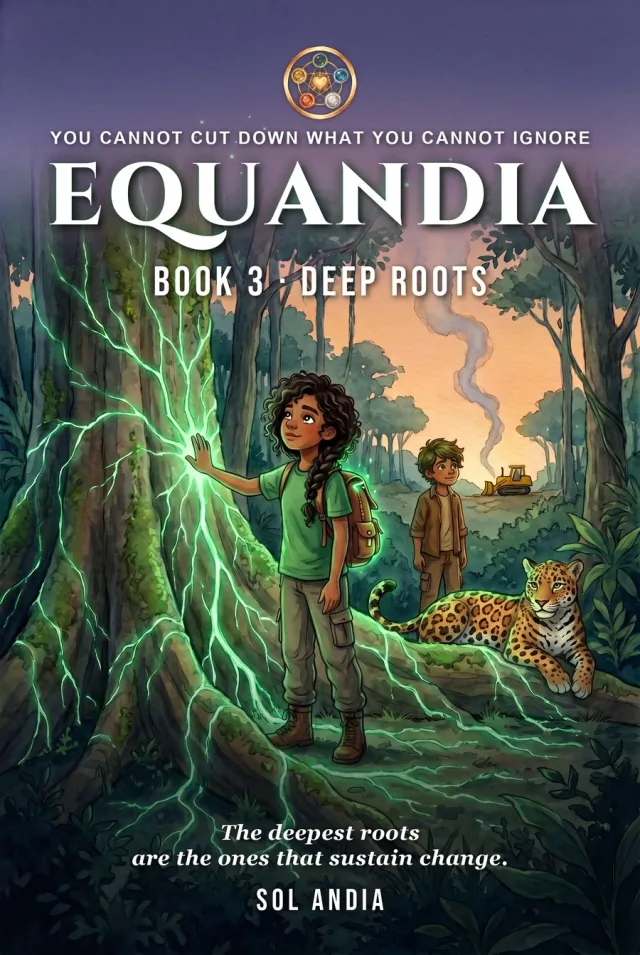
Cover of Equandia 3: Deep Roots
FREE EXCERPT · FULL CHAPTER 1

Book 3 · Deep Roots

The deepest roots are the ones that hold up change.

Luna, age 12 · Equandia series, book 3 of 5 · Sol Andia

For parents and teachers: Equandia blends real science with magical realism. The science and the safety measures in the series are real and verifiable; the Guardians' gift is fantasy: in the real world, no person or technology can predict an earthquake.

CHAPTER 1
Two Years Later (Again)
Illustration for Chapter 1 of Equandia 3: Deep Roots

Biome: Central Valley of Equandia

Luna: age 12

Time: 2 years after Book 2

Theme: From individual activism to systemic activism

Lesson: Testifying before power takes courage, but also evidence


Luna Solari was twelve years old and tired of adults pretending to listen.

Sitting in the National Assembly, surrounded by politicians in expensive suits and fake smiles, Luna watched the Minister of Economic Development present the "Green Progress Project": fifty thousand hectares of tropical forest turned into oil palm plantations. The title glowed in golden letters on the giant screen behind the podium, as if gold could make destruction sound noble.

The room smelled of old leather and stale coffee. Fifty red velvet chairs, each one filled by a representative elected to protect Equandia. In theory. In practice, Luna knew that many of them took "donations" from corporations like GloboCorp. It wasn't corruption, technically. It was "campaign contributions." But the result was the same: they sold the future for votes.

"It's sustainable development," said the minister, a man of sixty with perfect silver hair and a blue tie that probably cost more than a teacher's monthly salary. He pointed at optimistic charts full of rising green arrows. "We'll create five thousand jobs. We'll raise GDP by three percentage points. And all of it while respecting the environment."

Luna clenched her fists. The word "sustainable" had lost all meaning. Now it was what corporations said when they wanted to destroy something without feeling guilty.

She wore the uniform of the School of Signals: a dark green shirt with the logo stitched over the chest, an Earth with deep roots growing out of it. The symbol Rosa had designed sixty years ago. At twelve, Luna was the youngest Guardian ever to testify before Congress. Not because she was special. But because she had learned something most adults forgot: evidence wins arguments, not emotions.

In her AMI backpack, worn now from four years of hard use, she carried something more powerful than any gadget: data. Numbers. Verifiable facts. And satellite photos that showed exactly what GloboCorp planned to destroy.

Luna raised her hand. Slowly. Steadily.

"May I ask a question?" Her voice sounded firmer than it had at eight, when no one listened to her. She had learned to project. To stand up straight. To look people in the eye. Rosa had taught her: "Power listens to you only if you act like you deserve to be heard."

The minister smiled. It was the condescending smile adults use with children they find cute but irrelevant.

"Of course, young lady."

Young lady. Luna hated that word. It wasn't her name. It was a way of reminding her that her age disqualified her. As if years of life determined the validity of an argument.

"How is it 'sustainable' to destroy primary forest that took a thousand years to grow and replace it with a monoculture that drains the soil in one or two decades?"

An uncomfortable silence. Some representatives shifted in their seats. Others looked at their phones, pretending they hadn't heard.

"Well, that's a rather... simplistic point of view," the minister said, adjusting his glasses, buying time to come up with an answer that sounded official without saying anything. "Economic reality is more complex. We need a balance between conservation and progress."

"Simplistic?" Luna pulled out her tablet. The screen lit up with data she had gathered over three months. "According to your own figures, you're going to cut down the forest where my friend Gael lives. Ember Forest. Home to three hundred endemic species. Seventeen of them critically endangered, including the Ember jaguar, which exists nowhere else. Where exactly is the 'balance' when we wipe out species that will never come back?"

She projected her screen onto the wall. Satellite images appeared: Ember Forest from space, a dark green stain of fifty thousand hectares. Then the simulation of what it would become after the project: a geometric grid of oil palms, like soldiers in formation, no diversity, no wildlife, no soul.

The minister's smile faded.

"Progress requires sacrifices..."

"Sacrifice WHAT exactly?" Luna stood up. At twelve, she was 1.52 meters tall. The minister was fifty centimeters taller. But in that moment, he looked small. "Because you don't live there. You won't breathe the polluted air when they burn the forest to 'clear' the land. You won't drink the water poisoned by the pesticides they'll use on the plantations. You won't watch the jaguars starve to death because their territory is gone.

Luna walked toward the podium. Her steps echoed in the absolute silence of the room.

Children do. The ones of us who live there. The ones who inherit your decisions. And you'll be long gone when the planet collapses because of choices like this one, but we'll be alive to suffer it. Do you think that's fair?"

A murmur ran through the room. Some representatives applauded. Others frowned, as if Luna had said something inappropriate. Telling the truth in Congress, apparently, was inappropriate.

The minister regained his composure. He drank some water. He took a deep breath.

"Miss Solari, I understand your passion, but we adults have experience..."

"It's not passion. It's data." Luna connected her tablet to the Congress projector. Someone from the tech crew tried to stop her, but Mateo, her friend who knew the law and was sitting in the audience, had taught her that as an invited witness she had the right to present evidence. "I'm going to show you exactly what you're going to destroy."

And for the next ten minutes, Luna presented the most devastating case Congress had ever heard from a twelve-year-old:

Slide 1: Satellite map of Ember Forest

"Fifty thousand hectares. The last intact primary forest on Equandia's coastal region. It has never been logged. The oldest trees are eight hundred years old."

Slide 2: Biodiversity analysis

"Three hundred recorded species. Forty-two species of mammals. One hundred seventy- eight species of birds. Seventeen endemic species that exist nowhere else on the planet. If you destroy this, those species vanish. They don't 'relocate.' They vanish. Forever."

Slide 3: Indigenous communities

"Four communities. Thirteen hundred people. They have lived there since before Equandia existed as a country. Their traditional medicine depends on plants from this forest. GloboCorp offered them 'compensation': twenty thousand dollars per family. How much is the land of your ancestors worth? Apparently, twenty thousand dollars."

Slide 4: Climate impact

"This forest captures hundreds of thousands of tons of CO2 a year. If they cut it down, that carbon goes back into the atmosphere. The equivalent of putting two hundred thousand more cars on the roads. And oil palm plantations capture ninety percent less carbon than primary forest. Simple math: this speeds up climate change."

Slide 5: Water contamination

"Three major rivers flow out of this forest. They provide drinking water to three million people. The pesticides GloboCorp will use on the plantations will seep into the aquifer. Contaminated water. For three million. Does anyone here drink water? Imagine that it's poison."

Slide 6: Gael's testimony

Luna played the video Gael had recorded a week earlier. Her mentor and friend, twelve years old, standing in the forest, explaining in a calm but firm voice why this place mattered. He showed the jaguar he called Sombra. The giant trees. The children of his community playing in the river.

"This is my home. And you're going to destroy it to plant palms that are harvested only for oil. Oil that gets used for... what? Processed snacks? Shampoo? Is that worth more than a jaguar?"

The video ended. Several representatives had tears in their eyes.

Luna turned off the projector. She turned to face the minister.

"One last question: if you won't be alive to see the consequences of this decision, what gives you the right to make it?"

The Minister of Economic Development had no answer. He opened his mouth. He closed it. He looked at his notes. He looked at the president of Congress, hoping to be rescued.

The president of Congress, a man of seventy who had spent thirty years in politics, looked at Luna with something strange in his eyes. Respect? Fear? Guilt?

"Thank you, Miss Solari. We will take your testimony into consideration."

Take it into consideration. Political language for "we hear you but we won't do anything."

Luna stepped down from the podium. She walked between the rows of representatives. Some murmured "well done" to her. Others avoided her eyes. Mateo was waiting for her at the exit, with a proud smile.

"You were incredible," he told her.

"It didn't work," Luna answered. "I can see it in their faces. They already decided. The testimony is just theater."

"But the whole country saw you. It was broadcast live. Fifty million people."

Luna didn't see what difference that made. Fifty million people watching didn't stop bulldozers.

The next day, just as Luna had predicted, the project was approved. Forty-two votes in favor. Eight against. The Green Progress Project would begin in two weeks.

Luna left Congress feeling something she hadn't felt in two years: helplessness.

She walked alone through the streets of the Central Valley. It was noon. The sun beat down hard. Tourists took selfies in front of historic buildings. Street vendors offered mangoes and pineapples from colorful carts. The normal life of a city that didn't know, or didn't care, that it had just approved the destruction of fifty thousand hectares of forest.

Luna passed a café where adults drank five-dollar lattes. Did they know that the palm oil in their cookies came from forests like Gael's? Probably not. Or if they did know, they had learned not to think about it. It was easier that way.

On a corner, a group of schoolchildren waited for the bus. Eight, nine years old. The age Luna had been when she detected her first tsunami. These kids played on their phones, oblivious. In twenty years, when the planet was collapsing, they would be the age Luna was now. And they would ask: "Why didn't the adults do anything?"

Luna stopped in front of a shop window. Her reflection looked back at her. School of Signals uniform. AMI backpack. Hair pulled into a braid. Twelve years old. And tired. So tired.

She took out her phone. She opened social media. Her testimony already had three million views. Thousands of comments:

"This girl has more courage than all the politicians put together."

"Sharing this. The world needs to see it."

"My daughter is her age. Thank you for giving her an example of bravery."

But also:

"A little girl doesn't understand economics. Adults know better."

"Typical emotional activism. Where's the DATA?"

"If she cares so much, let her buy the forest herself."

Luna closed her phone. Three million views. And zero change. Views didn't save trees.

At eight, she could stop tsunamis because nature gave warning. The animals fled. The sea pulled back. There were signals. And Luna was an expert at reading signals.

At twelve, she couldn't stop politicians because they simply... ignored. There was no signal to read when the enemy decided, fully aware, to destroy. That wasn't a natural disaster. It was a human disaster. And Luna had no gadget for that.

"It didn't work," she told her mother, Isabel, that night, the two of them sitting in the kitchen of their house. The kitchen where Luna had eaten breakfast before her first earthquake. Where she had celebrated every victory of the last four years. Now it felt like a place of defeat.

Isabel, now director of the Institute of Climate Studies and the government's environmental advisor (a post that had done nothing to help her stop this project), hugged her daughter.

"I didn't expect it to work," Isabel said with brutal honesty. "The government approved this project six months ago in secret meetings. The public testimony was just a formality. They knew environmental groups would protest. So they scheduled the testimony, let us speak, and then voted the way they had already planned."

"Then why testify at all?" Luna felt betrayed. If her mother knew it was pointless, why had she let her do it?

"Because now all of Equandia has seen you. Fifty million people saw a twelve-year-old girl take on the government with real data. They saw that the minister had no answer. They saw that they voted anyway." Isabel took Luna's hands. "And that, my love, is only the beginning."

"The beginning of what?"

"Of collective anger. Politicians have power. But in a democracy, that power comes from voters. And you just made fifty million voters angry. Some will do nothing. But some... some will rise up."

Luna didn't understand. If this was only the beginning, what came next?

The answer came three days later, at 11:47 PM, when Gael called her. Luna was half asleep. Her phone buzzed. She saw the name: GAEL - EMBER FOREST.

"Luna?" Gael's voice was broken. He had been crying. "They started."

Luna sat up in bed, wide awake.

"Started what?"

"Logging. They showed up with machines this morning. Bulldozers. Chainsaws. There are... there are hundreds of workers. They're destroying everything. Luna, I can hear the trees falling from my house. Every... every tree sounds like thunder. And I can't do anything. Just listen."

Luna listened to Gael sob. Her best friend. The boy who had faced forest fires without crying. The leader of the Youth Fire Prevention Brigade. Broken.

"Gael, breathe. Where are you?"

"At the edge of the forest. Trying to... I don't know. Document it. But it's... Luna, it's a massacre. A five-hundred-year-old tree gone in thirty seconds."

Luna felt something ignite in her chest. It wasn't the hum she felt before natural disasters. It was something different. Hotter. More dangerous.

It was rage.

"Can you record?" Luna asked.

"What?"

"Record everything. Every tree that falls. Every machine. Every worker. I need evidence."

"What for? You already testified. It didn't work."

"Gael, listen to me." Luna stood up. She started packing her AMI backpack. "Testifying before the government didn't work. So we're going to skip the government. We're going straight to the people."

"I don't understand."

"Not yet. But you will. Record everything. I'm on my way. I'll be there by noon tomorrow."

"Luna... I don't know if there's anything you can do. There are too many of them. Too powerful."

Luna looked at her backpack. Four years of gadgets. Seismic meters. Water sensors. Wind detectors. All useless against bulldozers.

But maybe Luna didn't need gadgets.

Maybe she needed something simpler, and more terrifying to the corporations: witnesses. Thousands of them.

"Gael, do you trust me?"

"Always."

"Then record. And wait for me. We're going to do something GloboCorp will never see coming."

"What?"

Luna smiled. It wasn't a happy smile. It was the smile of someone who has just decided to fight.

"We're going to bring fifty thousand witnesses."

She hung up. She stared at her phone. Then she dialed another number. Tomás, her documentary-maker friend with half a million followers on social media, answered on the third ring.

"Luna, it's midnight..."

"Tomás, I need you to make something go viral. Tomorrow. Before noon."

"What?"

"I'll explain on the way. Get your cameras ready. We're going to Ember Forest."

"The forest they're cutting down?"

"The forest we're going to save."

Luna hung up before Tomás could ask how exactly they planned to save fifty thousand hectares. Because honestly, she didn't know either.

But she knew this: at eight, she detected natural disasters. At ten, she uncovered historical truths. At twelve, it was time to create political disasters.

For the corporations.

Luna grabbed her AMI backpack, now full of gadgets useless for this mission. She emptied it. In their place she packed: her laptop, a solar charger, three portable batteries, her tablet with all the testimony data, and Rosa's diary.

She wasn't going to detect signals from the Earth.

She was going to create signals the whole world couldn't ignore.

She went downstairs. Isabel was awake, drinking coffee in the kitchen. She looked at Luna's backpack. Then she looked at her daughter.

"Are you going to Ember Forest?"

"Yes."

"Alone?"

"For now."

Isabel nodded slowly. It was the look she got when she understood that arguing was pointless.

"What are you going to do?"

"Something Rosa would do." Luna set the diary on the table. "She told me once about the First Silence. When fifty young Guardians warned about the disaster and no one listened to them. Until it was too late."

"And?"

"And this time, we won't wait until it's too late. This time, we'll make so much noise they'll have no choice but to listen."

Isabel smiled. She had tears in her eyes.

"Your grandmother would be proud."

"I hope so." Luna hugged her mother. "Because what I'm about to do is probably illegal.

"How illegal?"

"Mass civil disobedience. Peaceful occupation of private land. Interruption of commercial operations." Luna counted on her fingers. "Organizing minors without parental permission. Possibly resisting authority if they send police."

Isabel laughed. It was a strange laugh, a mix of pride and terror.

"That's very illegal."

"I know. Are you going to arrest me?"

"I'm a climate scientist, not a cop." Isabel poured two cups of coffee. She passed one to Luna. "Besides, the mass arrest of fifty thousand students would be excellent publicity for GloboCorp. I don't think they'll risk it."

"Fifty thousand? How do you know there will be fifty thousand of us?"

"Because I saw your testimony. And I know there are fifty thousand students in Equandia who felt the same thing you did: helplessness. And helpless people who organize... stop being helpless."

Luna drank her coffee. It was too hot and too bitter. Perfect.

"Will you come?" Luna asked.

"Do you want me to?"

"I need adults. Scientists. People with credibility. The kids can shout. The adults can back it up."

Isabel nodded.

"Give me two days to organize. I know fifty scientists who are as angry as you are. Some have children at the School of Signals. We'll come."

"Thanks, Mom."

"Don't thank me. It's my planet too. I'm just borrowing it a little longer than you are."

Luna finished her coffee. She looked at the clock: 12:37 AM. In eleven hours, she would reach Ember Forest. In twelve hours, she would shift her strategy from detecting disasters to creating movements.

She picked up her AMI backpack, light now without gadgets, heavy with responsibility.

"One more thing," Isabel said before Luna left. "Rosa told me something the last time we talked. Something about you."

"What?"

"She said that at twelve, you would stop being a Guardian of disasters and become a Guardian of systems. She said it's harder. Because systems don't send clear signals. Systems lie. They deny. They confuse." Isabel put a hand on Luna's shoulder. "But she said you were the only one who could do it. Because you had learned the most important lesson: to listen."

"I don't understand how listening helps against corporations."

"Listening isn't only hearing the signals of disasters. It's hearing silenced voices. Like Gael. Like the indigenous communities who are losing their home. Like the fifty thousand students who want to help but don't know how." Isabel hugged Luna. "Your job isn't to detect disasters anymore. It's to amplify voices. And when you amplify fifty thousand voices... that's a disaster. For the corporations."

Luna hugged her mother. Then she went out to the night bus that would take her to Ember Forest.

She didn't know that in two weeks, she would be the leader of the largest student movement in the history of Equandia.

She didn't know that her grandmother Rosa would die in three months, passing on to her the last legacy.

She didn't know that in a year, three million students around the world would follow her template of resistance.

But she knew this: she was going to defend that forest. Or she would learn something worse than any tsunami.

That sometimes, the biggest disasters don't come from nature.

They come from humans who decide to ignore it.


The story continues…

A giant forest in danger, a network glowing beneath the earth, and fifty thousand voices that refuse to stay silent.
Keep reading the full Equandia 3: Deep Roots, with all 12 chapters and educational appendices.

Coming soon on Amazon See the whole series

eBook for Kindle and print edition. © 2026 Equandia · Sol Andia