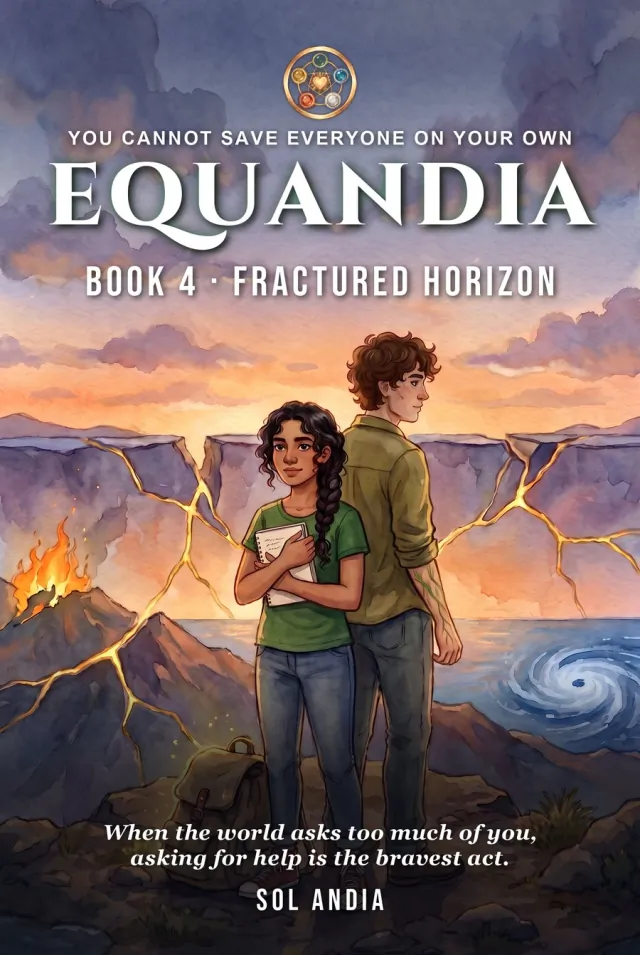
Cover of Equandia 4: Fractured Horizon
FREE EXCERPT · FULL CHAPTER 1

Book 4 · Fractured Horizon

When the world asks too much of you, asking for help is the bravest act of all.

Luna, ages 13-14 · Equandia series, book 4 of 5 · Sol Andia

For parents and teachers: Equandia blends real science with magical realism. The science and the safety measures in the series are real and verifiable; the Guardians' gift is fantasy: in the real world, no person or technology can predict an earthquake.

CHAPTER 1
The Weight of the Signals
Illustration for Chapter 1 of Equandia 4: Fractured Horizon

Biome: School of Signals, Central Valley

Luna: thirteen and a half

Time: one and a half years after Book 3

Signal: Emotional exhaustion (an internal signal)

Lesson: Recognizing when you need help is the first step toward strength

Luna Solari was thirteen and a half, and she felt as if she carried the world on her shoulders.

It wasn't the first time she had felt this way. But this time was different. This time, the weight didn't come from an approaching disaster or a mass evacuation. It came from something deeper, something she couldn't measure with sensors or predict with data.

It came from within.

It was Tuesday, 7:15 AM, and Luna sat on the edge of her bed at the School of Signals, staring at her tablet full of alerts. Seventeen notifications about minor disasters across Equandia. Five training requests from new Guardians. Twenty-three emails from governments asking for advice. And one message from Tomás, asking if she was okay.

Am I okay? Luna thought. It was a question she hadn't known how to answer lately.

Her mother, Isabel, knocked softly on the door.

"Luna, sweetheart. It's 7:15. You have training with the new Guardians at 8:00."

Luna looked at her reflection in the window. There were shadows under her eyes. Her hair, usually pulled into a perfect braid, was a mess. And for the first time in three years, she didn't feel like getting up.

"Mom... can I skip training today?"

Isabel came into the room. She knew her daughter better than anyone. And she recognized something in her voice she had never heard before: real exhaustion.

"Are you sick?"

"I don't know what to call it." Luna lowered her tablet. "I feel... tired. But not tired in my body. Tired of... everything."

Isabel sat on the bed beside Luna. She put a hand on her shoulder.

"Tell me what you've been feeling. Take your time."

Luna took a deep breath. It was hard to put into words something she barely understood herself.

The hum of Terran, which had been her constant companion for six years, felt distant. Like a radio tuned to the wrong station.

Luna had read about this. Guardians who wore themselves out sometimes lost their connection to the Primordials for a while. The body and the mind needed rest. The Primordials didn't leave; they simply waited until you were ready to listen again.

But knowing that didn't make it hurt any less.

"Yesterday I detected signals of an earthquake in the north. Magnitude 6.2. I felt it four hours before it hit. I activated the evacuation protocol. I coordinated with the local authorities. Everything worked perfectly. Zero casualties." She paused. "And when it was all over, when they confirmed everyone was safe, I just... felt empty."

"Empty how?"

"Like I should feel something. Happiness, relief, pride. Something. But I felt nothing. I just thought: 'What's the next disaster?'" Luna looked at her mother. "And that scared me."

Isabel hugged her daughter. She had seen this before in fellow scientists who worked on climate change: the exhaustion of carrying too much responsibility for too long.

"My love, what you're describing has a name. It's called compassion fatigue. Sometimes people also call it emotional burnout. It happens to people who give so much of themselves helping others, especially in situations of constant crisis."

"Is it... bad?"

"It's not bad, Luna. It's human." Isabel brushed the hair away from her face. "It means you've been giving so much of yourself for so long that your emotional energy needs to recharge. Like when AMI needs time to materialize new gadgets."

Luna nodded slowly. The comparison made sense.

"But Mom, I can't stop. The planet never stops giving signals. If I rest, people could..."

"Luna, stop right there." Isabel was gentle but firm. "How many Guardians are there in Equandia now?"

"More than two hundred."

"Then there are more than two hundred people who can detect signals. You're not the only one." Isabel took Luna's hands. "Sweetheart, you've been a Guardian since you were eight. That's five and a half years working almost without a break. Do you know how many full days of rest you've taken in all that time?"

Luna thought about it. She really thought about it.

"I... I'm not sure."

"I do. I counted them. Sixteen days. In five and a half years." Isabel let that number sink in. "Luna, that's less than five days of rest a year. Adults need at least thirty days. Children need more."

"But I'm not a normal kid..."

"You are exactly a normal kid. With an extraordinary gift, yes. But you're still a thirteen-year-old girl who needs to sleep, to play, to rest, and to have time to be simply Luna, not Luna the Guardian."

Tears began to fall down Luna's cheeks. They weren't tears of sadness, but of relief. Relief that someone finally understood what she had been feeling but hadn't known how to put into words.

"I feel selfish for being tired."

"You're not. Not at all." Isabel hugged her tighter. "You know what every airline pilot says before takeoff? 'In case of emergency, put on your own oxygen mask first before helping others.' Do you know why?"

"Because you can't help anyone if you run out of oxygen yourself."

"Exactly. Taking care of yourself isn't selfish, Luna. It's what lets you keep helping others in the long run."

Luna wiped away her tears. Her mother was right. Logically, it made all the sense in the world. But emotionally, she still felt that asking for help was a weakness.

"So what do I do?"

"First, we're going to cancel your training today. I'll take care of letting them know. Second, we're going to have breakfast together, without talking about disasters or signals. And third..." Isabel pulled a card out of her pocket. "We're going to make an appointment with someone who can help you much more than I can."

Luna read the card:

Dr. Patricia Méndez

Clinical psychologist specializing in young leaders and activists

"Strength also lies in knowing when to ask for support"

"A psychologist?"

"An excellent psychologist. She works specifically with young people who carry big responsibilities: elite athletes, young entrepreneurs, youth activists. She understands the unique pressure you face."

Luna looked at the card. Part of her resisted. Didn't going to therapy mean that something was "wrong" with her? But another part, the part that was exhausted, felt curious. Maybe someone who understood could help her understand what she was feeling.

"Can I think about it?"

"Of course. But Luna, I want you to know something: asking for professional help isn't admitting defeat. It's the opposite. It's recognizing that you deserve support. That you deserve care. That you deserve to be more than just a Guardian."

Isabel kissed Luna's forehead and stood up.

"I'll be waiting for you in the kitchen in fifteen minutes. I'm going to make your favorite pancakes. And today, just for today, we're going to be a mother and daughter having breakfast together. No tablet. No alerts. No weight of the world."

When Isabel left, Luna stayed sitting on her bed. She looked at her tablet, full of blinking notifications. Then she looked at Dr. Méndez's card.

She made a decision.

She turned the tablet off completely. Something she hadn't done in months.

And for the first time in a long time, she felt something other than emptiness.

She felt hope.

Maybe, just maybe, it was okay to ask for help.


Three days later, Luna walked into Dr. Patricia Méndez's office for the first time. It was a cozy space: cream-colored walls, potted plants, a large window looking out on the mountains, and comfortable armchairs instead of the usual formal desk.

Dr. Méndez was a woman of about forty, with brown hair gathered in a loose bun, purple-framed glasses, and a warm smile that immediately made Luna feel a little less nervous.

"Luna, welcome. You can sit wherever you feel most comfortable."

Luna chose the armchair by the window. From there she could see the mountains of the Central Valley, the same ones she had helped protect from landslides a year earlier.

Dr. Méndez sat across from her, not behind a desk, but in another armchair. As an equal.

"Before we begin, I want you to know a few things about how I work." Dr. Méndez spoke in a calm but clear voice. "First, this is your safe space. There are no judgments here. Second, everything you tell me is confidential, unless there's a risk of immediate harm. And third, I'm not here to 'fix' you, because you're not broken. I'm here to help you understand what you're feeling and give you tools to manage it."

Luna nodded slowly. It already felt different from what she had imagined.

"Your mom told me a little about you. But I want to hear it from you directly. What brings you here today?"

Luna didn't know where to begin.

"I'm... tired. Emotionally. And I don't know what to do about it."

"Tell me more about that tiredness. When did you start noticing it?"

"A few months ago, I think. At first I thought it was just lack of sleep. But then I realized that even when I slept well, I still felt exhausted." Luna looked out the window. "And the worst part is that I don't feel anything anymore when I help people. Before, when I saved lives, I felt happy. Now I just feel... nothing."

"That must be very confusing. And probably frightening."

"Yes. Because I'm supposed to be the Guardian. This is supposed to be my purpose. If I don't feel anything doing it anymore, what does that mean?"

Dr. Méndez leaned forward a little.

"Luna, what you're describing is something that happens to many people who work in helping professions: doctors, firefighters, social workers, and yes, young activists like you. It's called compassion fatigue or empathy fatigue. Have you heard those terms?"

Luna shook her head.

"It's what happens when you give so much of your emotional energy helping others that your reserve runs dry. Imagine your emotional capacity is like a battery. Every time you help someone, you use up a little of that battery. Normally, you rest and the battery recharges. But if you keep using the battery without ever recharging it, eventually it drains completely."

The comparison was simple, but Luna understood it right away.

"My battery is... empty."

"Not completely empty, or you wouldn't be here. But very low, yes. And that's not your fault, Luna. It's a natural consequence of working under constant pressure without enough moments to recover."

"But I can't just stop. There are disasters that..."

Dr. Méndez raised a hand gently.

"I'm not asking you to stop. I'm asking you to learn to recharge your battery while you keep helping. Because Luna, if you don't, eventually your battery won't just drain, it will get damaged. And then you really won't be able to help anyone."

Luna thought about that. It made sense. But still...

"How am I supposed to recharge my battery? It's not like I can take a vacation while the planet is in a climate crisis."

"Excellent question. And we're going to work on that together." Dr. Méndez took out a notebook. "But first, I need to understand your daily routine better. Describe a typical day for me."

Luna took a deep breath.

"I get up at 5:30 AM. I check the global seismic sensors and weather patterns on my tablet. At 6:30, a quick breakfast. At 7:00, training with new Guardians. At 9:00, regular classes: math, science, history. At 2:00 PM, meetings with the #DeepRoots movement about awareness campaigns. At 4:00, video calls with other Guardians in different time zones. At 6:00, dinner. At 7:00, reviewing the day's data. At 9:00, I try to sleep. But usually my mind keeps thinking about signals, so I don't fall asleep until around 11:00."

Dr. Méndez wrote as Luna spoke.

"So, about five and a half hours of sleep a night. And when was the last time you did something just because you like doing it, with nothing to do with being a Guardian?"

Luna thought about it. She really thought about it. And she couldn't remember.

"I... I don't know."

"Do you have friends outside the Guardians' movement?"

"Gael and Tomás are my best friends. But we're always working together."

"When was the last time you spent time with them just having fun? Watching a movie, playing games, laughing without talking about work."

Luna felt a lump in her throat.

"I don't remember."

"Do you have hobbies? Things you enjoy doing for fun?"

"I used to like drawing. And reading fiction. But... I don't have time anymore."

"Or do you feel that you shouldn't have time for that?"

Luna went quiet. Dr. Méndez had just touched something deep.

"I feel that if I spend my time drawing or reading, I'm being selfish. Because in that time, I could be monitoring signals. I could be training more Guardians. I could be saving lives."

Dr. Méndez nodded understandingly.

"Luna, that's what we call an overgrown sense of responsibility. It's when you feel you're responsible for everything and that any moment you use for yourself is time stolen from others. Does that make sense?"

"Yes. That's exactly how I feel."

"Then let me ask you something: if Gael were so exhausted that he could barely function, what would you tell him?"

"I'd tell him to rest."

"And if Tomás told you he felt guilty for taking a day off?"

"I'd tell him not to be silly, that he needs to take care of himself."

"So why don't you give yourself the same compassion?"

Luna opened her mouth to answer, but she couldn't. Because she didn't have a logical answer.

Dr. Méndez smiled gently.

"Luna, one thing we're going to work on a lot in our sessions is self-compassion. Treating yourself with the same kindness you give to others. Because here's the truth: you can't pour from an empty well. If you don't take care of yourself, eventually you'll have nothing left to give."

"So... what do I do?"

"Together we're going to create what I call a Sustainable Self-Care Protocol. It's like the evacuation protocols you create, but this one is for your emotional well-being." Dr. Méndez took out a sheet of paper. "And it will include things like work limits, mandatory rest time, recharge activities, and strategies for when you feel your emotional battery running low."

For the first time in weeks, Luna felt something close to relief.

"Does that work?"

"It works if you commit to following it. And it won't be easy, Luna. Because it requires you to accept something very hard: that you can't do it all on your own. That it's okay to ask for help. That it's okay to say no. And that it's okay to set limits, even when you feel the world needs more from you."

Luna took a deep breath.

"It sounds terrifying."

"It is. But it's also freeing." Dr. Méndez smiled. "And you're not alone in this. I'm going to be here with you, step by step."

"How long does it take... to feel normal again?"

"Every person is different. But typically, with weekly sessions and conscious work applying the strategies, you start to feel improvement in six to eight weeks. And in twelve weeks, most of my patients report that they feel significantly better."

Luna nodded. Twelve weeks. Three months. It seemed like a long time. But it also seemed manageable.

"And what if I fail? What if I can't follow the protocol and someone is lost because of me?"

"That's the most important question you've asked today." Dr. Méndez leaned forward. "Luna, here's the truth you need to hear: you are not responsible for saving everyone. You never have been. Yes, you have an incredible gift. Yes, you've saved thousands of lives. But you're not superhuman. You're human. With human limits. And accepting those limits isn't failure. It's wisdom."

Tears began to fall down Luna's cheeks. Not from sadness, but from something deeper. It was as if someone had finally given her permission to be imperfect.

"I'm scared."

"I know. And it's okay to be scared. Fear is a sign that you're about to do something important." Dr. Méndez handed her a box of tissues. "But you don't have to face that fear alone. You have your mom. You have Gael and Tomás. You have me. And you have more than two hundred Guardians all over the world who can help too."

Luna dried her tears and nodded.

"Where do we start?"

"With the simplest thing: this week, your only task is to sleep eight hours every night. Nothing more. Just sleep."

"That's it?"

"That's it. Because sleep is the foundation of everything else. Once your body is rested, we'll work on the rest. Can you commit to that?"

Luna thought about her current five hours of sleep. Eight hours meant giving up three hours of nighttime monitoring. But if Dr. Méndez was right, it meant having more energy during the day.

"I can try."

"Perfect. See you next week."

When Luna left the office, the sun was beginning to set over the mountains. She picked up her tablet, but instead of opening it right away to check alerts, she paused for a moment to watch the sunset.

It was orange and purple. Beautiful.

And she realized she hadn't watched a whole sunset in months.

Maybe, just maybe, Dr. Méndez was right.

Maybe it was okay to start living again.


The story continues…

Even the strongest Guardian can break. This is the book about putting yourself back together.
Keep reading the full Equandia 4: Fractured Horizon, with all 12 chapters and educational appendices.

Coming soon on Amazon See the whole series

eBook for Kindle and print edition. © 2026 Equandia · Sol Andia